Saturday, January 27, 2024

Best ways to make money online

 Best ways to make money online


There are several ways to make money online, and here are some of the best methods:


Freelance work: You can find freelance jobs on websites like Upwork, FlexJobs, and SolidGigs [1]. These platforms offer a wide range of remote freelance jobs in various fields such as web design, writing, graphic design, and project management.


YouTube channel: Starting a YouTube channel allows you to earn money through AdSense ads, promoting products, and creating sponsored content [1]. You can monetize your videos by adding ads, promoting products, or partnering with brands.


Dropshipping business: With dropshipping, you can sell products online without having to store inventory. You act as a middleman between the supplier and the customer, earning a profit by marking up the products [1].


Online surveys: Some websites offer paid online surveys where you can earn cash or gift cards by sharing your opinions. Websites like Branded Surveys and InboxDollars are popular options [1][2].


Blogging: Creating a blog allows you to monetize your content in various ways. You can sell digital products, become an affiliate marketer, or display ads through platforms like AdSense [1].


Writing and publishing an ebook: If you have expertise in a specific topic, you can write and publish an ebook to make money online. You can sell it on your blog or through platforms like Amazon [1].


App development: Developing your own app or working for a company as an app developer can be a profitable online venture. You can create apps that offer gamification, dedicated communities, or interactive content [1].


Virtual tutoring: If you have teaching experience or specialized knowledge, you can become a virtual tutor and help students improve their grades. Platforms like VIPKid and Chegg Tutors connect tutors with learners [1].


Influencer marketing: If you have a strong presence on social media or YouTube, you can become an influencer and earn money by promoting products or services. Brands may approach you for collaborations and sponsorships [1].


Website development: With the increasing demand for websites, web designers are in high demand. You can offer your services to businesses or individuals looking to create a website [1].


Learn more:


How to Make Money Online: 11 Ways to Earn Money Online | Mailchimp

17 Ways to Make Money Online in 2023) | TIME Stamped

20 + Ways to Make Money Online in 2024

Wednesday, August 17, 2022

Who is Oromo?

Who is Oromo?


LOCATION: Ethiopia; Kenya; Somalia


POPULATION: More than 60 million


LANGUAGE: Afaan Oromoo


RELIGION: Original Oromo religion (Waaqa); Islam; Christianity


1 • INTRODUCTION


Although Oromos have their own unique culture, history, language, and civilization, they are culturally related to Afars, Somalis, Sidamas, Agaws, Bilens, Bejas, Kunamas, and other groups. In the past, Oromos had an egalitarian social system known as gada. Their military organization made them one of the strongest ethnic groups in the Horn of Africa between the twelfth and nineteenth centuries. Gada was a form of constitutional government and also a social system. Political leaders were elected by the men of the community every eight years. Corrupt or dictatorial leaders would be removed from power through buqisu (recall) before the official end of their term. Oromo women had a parallel institution known as siqqee. This institution promoted gender equality in Oromo society.


Gada closely connected the social and political structures. Male Oromos were organized according to age and generation for both social and political activities. The gada government was based on democratic principles. The abba boku was an elected "chairman" who presided over the chaffee (assembly) and proclaimed the laws. The abba dula (defense minister) was a government leader who directed the army. A council known as shanee or salgee and retired gada officials also helped the abba boku to run the government.


All gada officials were elected for eight years. The main qualifications for election included bravery, knowledge, honesty, demonstrated ability, and courage. The gada government worked on local, regional, and central levels. The political philosophy of the gada system was embodied in three main principles: terms of eight years, balanced opposition between parties, and power sharing between higher and lower levels. These checks and balances were created to prevent misuse of power. The goverment's independent executive, legislative, and judicial branches also were a way of balancing power. Some elements of gada are still practiced in southern Oromia.


The gada system was the basis of Oromo culture and civilization. It helped Oromos maintain democratic political, economic, social, and religious institutions for many centuries. The gada political system and military organization enabled Oromos defend themselves against enemies who were competing with them for land, water, and power. Today, Oromos are engaged in a national liberation movement. Under the leadership of the Oromo Liberation Front (OLF) they work to achieve self-determination. Most Oromos support this liberation organization and its army, the Oromo Liberation Army. There are many Oromo organizations in North America, Europe, and Africa that support the Oromo national movement. Oromos are struggling for the opportunity to rule themselves and reinvent an Oromian state that will reflect the gada system.


2 • LOCATION


Oromos call their nation and country Oromia. They have been living in the Horn of Africa for all of their known history. They are one of the largest ethnic groups in Africa, with a population estimated at 28 million people in the mid-1990s. Oromia is located mainly within Ethiopia and covers an area of about 232,000 square miles (600,000 square kilometers). The 3.5 million-year-old fossilized human skeleton known as "Lucy" (or "Chaltu" in Oromo) was found by archaeologists in Oromia. Present-day Oromos also live in Kenya and Somalia. In the late nineteenth century, Oromos were colonized and mainly joined with- Ethiopia. They lost their independent institutional and cultural development. Great Britain, France, and Italy supported the Ethiopian colonization of Oromos.


Oromia is considered the richest region of the Horn of Africa because of its agricultural and natural resources. It is considered by many to be the "breadbasket" of the Horn. Farm products, including barley, wheat, sorghum, xafi (a grain), maize, coffee, oil seeds, chat (a stimulant leaf), oranges, and cattle are raised in abundance in Oromia. Oromia is also rich in gold, silver, platinum, marble, uranium, nickel, natural gas, and other mineral resources. It has several large and small rivers used for agriculture and for producing hydroelectric power.


3 • LANGUAGE


The Oromo language is called Afaan Oromoo. Afaan Oromoo has more than thirty million speakers. Ethnic groups such as the Sidama, Berta, Adare, Annuak, Koma, Kulo, Kaficho, and Guraghe speak the Oromo language in addition to their own languages. Afaan Oromoo is the third most widely spoken language in Africa, after Arabic and Hausa. It is the second most widely spoken indigenous language in Africa south of the Sahara.


In spite of attempts by Ethiopian regimes to destroy the Afaan Oromoo language, it has continued to exist and flourish in rural areas. Until recently, Oromos were denied the right to develop their language, literature, and alphabet. For almost a century, it was a crime to write in this language. With the rise of the Oromo national movement, Oromo scholars adopted Latin script (the alphabet used for English and most other European languages) in the early 1970s. The OLF adopted this alphabet and began to teach reading and writing in Afaan Oromoo.


4 • FOLKLORE


Oromos believe that Waaqa Tokkicha (the one God) created the world, including them. They call this supreme being Waaqa Guuracha (the Black God). Most Oromos still believe that it was this God who created heaven and earth and other living and non-living things. Waaqa also created ayaana (spiritual connection), through which he connects himself to his creatures. The Oromo story of creation starts with the element of water, since it was the only element that existed before other elements.


Oromos believed that Waaqa created the sky and earth from water. He also created dry land out of water, and bakkalcha (a star) to provide light. With the rise of bakkalcha, ayaana (spiritual connection) emerged. With this star, sunlight also appeared. The movement of this sunlight created day and night. Using the light of bakkalcha, Waaqa created all other stars, animals, plants, and other creatures that live on the land, in air, and in water. When an Oromo dies, he or she will become spirit.


Some Oromos still believe in the existence of ancestors' spirits. They attempt to contact them through ceremonies. These ancestral spirits appear to relatives in the form of flying animals.


Original Oromo religion does not believe in hell and heaven. If a person commits a sin by disturbing the balance of nature or mis-treating others, the society imposes punishment while the person is alive.


Oromo heroes and heroines are the people who have done something important for the community. Thinkers who invented the gada system, raagas (prophets), and military leaders, for example, are considered heroes and heroines. Today, those who have contributed to the Oromo national movement are considered heroes and heroines.


5 • RELIGION


Oromos recognize the existence of a supreme being or Creator that they call Waaqa. They have three major religions: original Oromo religion (Waaqa), Islam, and Christianity.


The original religion sees the human, spiritual, and physical worlds as interconnected, with their existence and functions ruled by Waaqa. Through each person's ayaana (spiritual connection), Waaqa acts in the person's life. Three Oromo concepts explain the organization and connection of human, spiritual, and physical worlds: ayaana, uuma (nature), and saffu (the ethical and moral code).


Uuma includes everything created by Waaqa, including ayaana. Saffu is a moral and ethical code that Oromos use to tell bad from good and wrong from right. The Oromo religious institution, or qallu , is the center of the Oromo religion. Qallu leaders traditionally played important religious roles in Oromo society. The Ethiopian colonizers tried to ban the Oromo system of thought by eliminating Oromo cultural experts such as the raagas (Oromo prophets), the ayaantus (time reckoners), and oral historians.


Today, Islam and Christianity are the major religions in Oromo society. In some Oromo regions, Eastern Orthodox Christianity was introduced by the Ethiopian colonizers. In other areas, Oromos accepted Protestant Christianity in order to resist Orthodox Christianity. Some Oromos accepted Islam in order to resist Ethiopian control and Orthodox Christianity. Islam was imposed on other Oromos by Turkish and Egyptian colonizers. However, some Oromos have continued to practice their original religion. Both Christianity and Islam in Ethiopia have been greatly influenced by Oromo religion.


6 • MAJOR HOLIDAYS


The Oromo celebrate ceremonial rites of passage known as ireecha or buuta , as well as Islamic and Christian holidays. The Oromos have also begun celebrating an Oromo national day to remember their heroines and heroes who have sacrificed their lives trying to free their people from Ethiopian rule.


7 • RITES OF PASSAGE


Since children are seen as having great value, most Oromo families are large. The birth of a child is celebrated because each newborn child will some day become a worker. Marriage is celebrated since it is the time when boys and girls enter adulthood. Death is marked as an important event; it brings members of the community together to say goodbye.


Traditionally Oromos had five gada (grades) or parties. The names of these grades varied from place to place. In one area, these grades were dabalee (ages one to eight), rogge (ages eight to sixteen), follee (ages sixteen to twenty-four), qondaala (ages twenty-four to thirty-two), and dorri (ages thirty-two to forty). There were rites of passages when males passed from one gada to another. These rites of passages were called ireecha or buuta.


Between the ages of one and eight, Oromo male children did not participate in politics and had little responsibility. When they were between eight and sixteen years old, they were not yet allowed to take full responsibility and marry. Between ages sixteen and twenty-four, they took on the responsibilities of hard work. They learned about war tactics, politics, law and management, culture and history, and hunting big animals. When young men were between twenty-four and thirty-two years of age, they served as soldiers and prepared to take over the responsibilities of leadership, in peace and war. Men thirty-two to forty years old had important roles. They shared their knowledge with the qondaala group and carried out their leadership responsibilities.


Nowadays, those who can afford it send their children to school. These children complete their teenage years in school. Children and teenagers participate in agriculture and other activities needed for survival. Between the ages of sixteen and twenty-four, young Oromos marry and start the lifecycle of adulthood.


8 • RELATIONSHIPS


Oromos are friendly people, and they express their feelings openly. Oromos greet one another by shaking hands; they talk to one another warmly. Asahama? (How are you?) , Fayaadha? (Are you healthy?), and Matinkee atam? (Is your family well?) are common greeting phrases or questions. The other person answers, Ani fayaadha (I am fine), Matinkos nagadha (My family is o.k.), and Ati fayaadha? (What about you, are you fine?).


When Oromos visit other families, they are provided with something to drink or eat. It is expected that visitors will eat or drink what is offered. People can drop by and visit friends or relatives without letting them know ahead of time.


Dating is an important step for a boy and a girl. Usually a young boy begins by expressing his love for a girl whom he wants to date. When a girl agrees that she loves him, too, they start dating. Premarital sex is not accepted, but kissing and dancing are acceptable. Parents are not usually told about a dating relationship. Dating may or may not lead to marriage. Having girlfriends and boyfriends gains young people social status and respect from others.


9 • LIVING CONDITIONS


Since Oromos are colonial subjects, their natural resources are extracted mainly by wealthy and powerful Ethiopians and their supporters. Most Oromos are rural people who lack basic services such as electricity, clean water, adequate housing, reliable transportation, clinics, and hospitals. Electricity that is produced by Oromian rivers is used mainly by Amhara and Tigrayans.


Hunger is a problem among the Oromo and many attribute it to exploitation by the Ethiopian government. Since Oromos have been denied education by a successive series of Ethiopian regimes, the Oromo middle class is very small. The living conditions of this class, however, are better than those of most Oromos. Members of this class mainly live in cities and towns.


Because of the military conflict between the Oromo Liberation Front army and the Ethiopian government army, Oromo peasants are constantly threatened, murdered, or imprisoned by the government. The Ethiopian government takes their property, claiming that the Oromo are hiding guerrilla fighters. Because of poverty, war, lack of modern farming methods, lack of education, and exploitation, the living standard of the Oromo people is very low. They live in overcrowded dwellings, which often house large extended families.


Oromos use human labor and animals such as donkeys and horses for transportation in rural areas. They use cars, wagons, buses, and trucks for transportation in cities and towns.


10 • FAMILY LIFE


The basic unit of a household is the patrilineal (male-headed) extended family. Neighborhoods and communities are important social networks connected to the extended family. A man, as head of the family, has authority over his wife (or wives) and unmarried sons and daughters. The typical Oromo man has one wife. But because of religious conversion to Islam and other cultural influences, some Oromo men marry more than one wife (a practice known as polygyny). Divorce is discouraged in Oromo society. Oromo women have begun to resist polygyny.


Because of patriarchy and sexism, Oromo women are treated as inferior to men and have little power. Oromo women live under triple oppression: class, gender, and ethnic/racial oppression. Before colonization, Oromo women had an institution known as siqqee to help them oppose male domination and oppression. Although there are Oromo women fighters and military leaders in the liberation struggle, the status of Oromo women has not changed.


11 • CLOTHING


Some Oromo men wear woya (toga-like robes), and some women wear wandabiti (skirts). Others wear leather garments or animal skin robes, and some women wear qollo and sadetta (women's cloth made of cotton).


Modern garments from around the world are also worn. In cash-producing areas and cities, Oromos wear modern Western-style clothes. Oromos have clothes designated for special days. They call the clothes that they wear on holidays or other important days kitii and the clothes that they wear on working days lago.


12 • FOOD


The main foods of Oromos are animal products including foon (meat), anan (milk), badu (cheese), dhadha (butter), and cereals that are eaten as marqa (porridge) and bideena (bread). Oromos drink coffee, dhadhi (honey wine), and faarso (beer). Some Oromos chew chat (a stimulant leaf).


The special dish of Oromos is itoo (made with meat or chicken, spices, hot pepper, and other ingredients) and bideena bread (made from xafi or millet). Sometimes mariqa or qincee (made from barley) is eaten for breakfast. Ancootee (a food made from the roots of certain plants) is a special food in some parts of western Oromia.


All members of the family eat together. Members of the family sit on stools, eat off wooden platters or dishes, use wooden spoons for liquids, and use washed hands to pick up solid foods. The majority of Oromos eat twice a day, in the morning and at night. Muslim Oromos do not eat pork for religious reasons.


13 • EDUCATION


Literacy (the ability to read and write) is very low among Oromos, probably less than 5 percent of the group. Oromos depend mainly on family and community education to transmit knowledge to the younger generation. Older family and community members have a responsibility to teach children about Oromo culture, history, tradition, and values. When children go to colonial schools, the Oromo oral historians and cultural experts make sure that these children also learn about Oromo society.


Although their numbers are very limited, there are three kinds of schools in Oromia: missionary, madarasa (Islamic), and government schools. Islamic schools teach classes through the sixth grade, and the other schools go through grade twelve. Oromos do not have control over these schools. Oromo culture and values are constantly attacked in them. Despite all these problems, Oromo parents have very high expectations for education. If they can afford it, they do not hesitate to send their children to school.


14 • CULTURAL HERITAGE


Oromos respect their elders and value social responsibility, helping others, bravery, and hard work. Knowledge of history and culture is admired. Oromos can count their family trees through ten generations or more. These values are expressed in geerarsa or mirisa (singing), storytelling, poems, and proverbs. Geerarsa is used to praise good behavior and discourage inappropriate behavior.


Oromo cultural heritage is expressed through mirisa, weedu, and different cultural activities. There are different kinds of weedu, such as weedu fuudha (a marriage song), weedu lola (a war song), and weedu hoji (a work song). Oromo women have their own song, called helee, that they use to express their love for their country, children, and husbands. Young boys invite girls to marriage ceremonies by singing hurmiso. Men do dhichisa (a dance to celebrate the marriage ceremony) and women do shagayoo (singing and dancing) during marriage ceremonies. There are prayer songs called shubisu and deedisu.


15 • EMPLOYMENT


Oromos are mainly farmers and pastoralists (herders). Young educated Oromos move to cities to look for jobs. There are also a small number of merchants in Oromo society, as well as weavers, goldsmiths, potters, and woodworkers.


16 • SPORTS


Hunting and practicing military skills were important sports in Oromia before it was colonized. Oromo men used to hunt large animals as a test of manhood. They used hides, ivory, and horns in their arts and crafts. Hunting was seen as training for warfare for young Oromos. It helped them learn how to handle their weapons and prepare themselves for difficult conditions.


Popular sports among children and young adults in Oromo society include gugssa (horseback riding), qillee (field hockey), darboo (throwing spears), waldhaansso (wrestling), utaalu (jumping), and swimming. Oromo society has produced athletes who have competed and won in international sports events. In 1956, Wami Biratu, an Oromo soldier serving in the Ethiopian colonial army, was the first Oromo athlete to participate in the Olympic Games. He became a source of inspiration for other Oromo athletes. Ababa Biqila, another Oromo soldier, won the 1960 Rome Olympic Marathon and set a new world record, running barefoot. Another Oromo soldier, Mamo Wolde, became the 1968 Olympic Marathon champion. Other Oromo soldiers have succeeded in international competitions as well.


In 1988, Ababa Makonnen (Ababa Biqila's nephew) won the Tokyo Marathon, and Wadajo Bulti and Kabada Balcha came in second and third. Daraje Nadhi and Kalacha Mataferia won first and second place, respectively, in the World Cup marathon in 1989. In 1992, Daraartu Tullu (1969–), an Oromo woman, won the gold medal for her victory in the 10,000-meter race in the Barcelona Olympic Games. In 1996, another Oromo woman, Fatuma Roba, became a women's marathon gold medalist. She was the first from Africa to win this kind of race, and she was the fastest marathon runner in the world. The successes of these Oromo athletes demonstrate the rich cultural heritage of athletic ability in Oromo society. The victories of these athletes went to Ethiopia.


17 • RECREATION


Oromos gather and enjoy themselves during ceremonies such as weddings, holidays, and harvest festivals. At these events they eat, drink, sing, dance, and talk together. Jumping, running, swimming, wrestling, and other sports activities are recreation for boys and young adults. Oromo adults like to sit and chat during weekends, after work, and on holidays.


18 • CRAFTS AND HOBBIES


There are Oromos who specialize in making musical instruments such as the kirar (five-stringed bowl-lyre), masanqo (one-stringed fiddle), and drums. Iron tools such as swords, spears, hoes, axes, and knives have been important for farming, fighting, and hunting. There is a long tradition of woodworking in this society. Carpenters make such objects as platters, stools, spades, tables, plows, bows and arrows, wooden forks, and honey barrels.


Goldwork has been practiced in some parts of Oromia. Goldsmiths specialize in making earrings, necklaces, and other gold objects. There are Oromos who specialize in making other utensils from horn, pottery, and leather. Mugs, spoons, and containers for honey wine are made from horn. Basins, dishes, water jars, and vessels are made from pottery. Various kinds of bags to hold milk are made from leather.


19 • SOCIAL PROBLEMS


Oromo's human rights and civil rights have been violated by one Ethiopian government after another. Oromos do not have control over their lives, lands, other properties, or country. They do not have a voice in the government, and they are not allowed to support independent Oromo political organizations. Oromos have been threatened, murdered, or imprisoned for sympathizing with the Oromo national movement, especially the OLF (Oromo Liberation Front). Oromos are not treated according to the rule of law.


Today thousands of Oromos are kept in secret concentration camps and jails just for being Oromo. Some Oromo activists or suspected activists are killed by Ethiopian soldiers. Their bodies are thrown into the streets to terrorize the Oromo people and to prevent them from supporting the Oromo national movement. Human rights organizations such as Africa Watch, the Oromia Support Group, and Amnesty International have witnessed many contracts aimed at reducing human rights abuses.


20 • BIBLIOGRAPHY


Abebe, Daniel. Ethiopia in Pictures. Minneapoli, Minn.s: Lerner Publications Co., 1988.


Fradin, D. Ethiopia. Chicago: Children's Press, 1988.


Gerster, Georg. Churches in Stone: Early Christian Art in Ethiopia. New York: Phaidon, 1970.


WEBSITES


Internet Africa Ltd. Ethiopia. [Online] Available http://www.africanet.com/africanet/country/ethiopia/ , 1998.


World Travel Guide, Ethiopia. [Online] Available http://www.wtgonline.com/country/et/gen.html , 1998.


Read more: https://www.everyculture.com/wc/Costa-Rica-to-Georgia/Oromos.html#ixzz7cEAElOH5


Read more: https://www.everyculture.com/wc/Costa-Rica-to-Georgia/Oromos.html#ixzz7cEA2vyI7

Saturday, August 13, 2022

Kitaabni mataduree "#Anaafi_Nuhi" jedhuun Doktar Taaddasaa Qana'aan barreeffame Yunivarsitii Ambootti eebbifame

Kitaabni mataduree "#Anaafi_Nuhi" jedhuun Doktar Taaddasaa Qana'aan barreeffame Yunivarsitii Ambootti eebbifame


Sirna kitaaba 'Anaafi Nuhii' ifoomsuu kanarratti hayyoonni, barreessitoonni kitaabilee, artistoonni bebbeekkamoofi keessummoonni gara garaa fagoofi dhiyoorraa argamaniiru.


Pirezidaantiin Yunivarsitii Amboo Doktar Baay'isaa Lataa sagantaa eebbaa kanarratti keessummootaan baga nagaan dhuftan jechuun Doktar Taaddasaadhaan ilma dabalataa abbaa 'Anaafi Nuhii' ta'uu keef baga gammadde jedhan.


Kitaaba barreessuun bu'aa bahii hedduu keessa darbee dadhabbii kan nama gaafatu waan ta'eef Doktar Taaddasaan abdii haarawaa argamsiisuuf ifaajee guddaa keessa darbee kitaaba kana nuuf gumaacheera, kanas dubbisuun gahee ummata keenyaati jedhan.


Barreessaan kitaaba 'Anaafi Nuhii' Doktar Taaddasaa Qana'aa (pirezidaantiin duraanii Yunivarsitii Amboo) yaada kennanin namni lubbuun jiru yeroo lubbuun jirutti hundi keenya waan gaarii dalaguu qaba jedha.


Fuuldurri keenya karaa dheeraadha. Galmi dhugaa salphaa miti. Dhugaan ilmoo Waaqi. Dhugaan beekumsa keessa jira. Kanaafis dubbisuu itti cichuu gaafata jedhan.


Nuhi keessa anatu jira; Ana keessa nuhitu jira; Waan taane hunda walumaan taane, waan argannes waan dhabnes walumaani, kanaaf waliin dhaabbachuutu falas jedhan.


Kaleessa maal keessa akka turre, har'a maal keessa akka jirrufi fuuldura keenyatti waan gaarii akeekuuf kitaabni muuxannoofi mudannoo gabbate kun ummata Oromoof bu'aa guddaa qaba jedheen barresse jedhan Doktar Taaddasaan.


WKShL

Monday, July 11, 2022

Vacancy Announcement Cooperative Bank of Oromia

Vacancy Announcement


Positions


  1. Digital Strategy and Transformation Specialist
    •Duty Station: Head Office
    •Place of Registration: Human Capital Management 📍 Africa Avenue (Bole Road), Dembel City Center 4th Floor (Kindly use lift number 6)
  2. Digital Strategy and Transformation Officer
    •Duty Station: Head Office
    •Place of Registration: Human Capital Management 📍 Africa Avenue (Bole Road), Dembel City Center 4th Floor (Kindly use lift number 6)
  3. Learning and Development Officer
    •Duty Station: Head Office
    •Place of Registration: Human Capital Management 📍 Africa Avenue (Bole Road), Dembel City Center 4th Floor (Kindly use lift number 6)
  4. Research and Innovation Officer
    •Duty Station: Head Office
    •Place of Registration: Human Capital Management 📍 Africa Avenue (Bole Road), Dembel City Center 4th Floor (Kindly use lift number 6)
  5. Branch Manager I
    • Duty Stations:
    =>Dire Enchini Branch ( Dire Enchini town), Under Western Finfinne District
    => Gedo Branch( Gedo town), Under Western Finfinne District
    •Place of Registration: Western Finfinne District 📍 ( Finfinne City, Mexico Behind Addis Ababa University School of Commerce)


For more information on qualifications and more, please visit our website:


https://coopbankoromia.com.et/jobs/


Coopbank #Bank #Ethiopia

Saturday, April 2, 2022

Seenaa Goticha Laggasaa Wagii Meettaa

Seenaa Goticha Laggasaa Wagii Meettaa


Jaal Lagaasaa Wagii abba isaani obbo Wagii Meettaa fi haadha isaani addee Buzunaash Ayyaana irraa bara 1960, Godina Shawaa Lixaa, konyaa Mannaa, Aanaa Shinoo Meettaa Roobii, ganda Kuyyuu Giccii jedhamtu keessatti dhalate. Jaal Lagaasaa Wagii umriin isaa barmootaaf yeroo gahu, mana baruumsa sadaarka tokkoffaa Bakkamee jedhamuuti kutaa 1-4 barate. Barnoota isaa kutaa 5-8 ammoo mana barumsaa Hinccinniitti barate. Sana booda gara Finfinneetti deemuun barumsa isaa itti fufuun kutaa 10-11 magaluuma Finfinneeti barate.Jaal Lagaassaa Wagii erga barumsa isaa haga kutaa 11ti barate booda barnoota akadaamii dhiisee baruumsa Makaanikummaa fi Konkoolaata oofu bara 1975 keessa barateera. Oguummaa isaa kananiis hojiilee adda addaa irraatti bobbahuun hojjaachaa ture. Jaala Laggaasaa Wagii hojii daldala irraatti bobbahuun magaala Dirree Dhawaa keessaati waggaa torbaaf kan jiraachaa turan yeroo tahu, hojiidhuuma daldala kanaaf meesha daldaala adda addaa fe’achuun gara Dhiha Oromiyaa deemuun daldala itti fufe.Jaal Laggaasaa Wagii obbolaa shan kan qabu yeroo tahu,Waxbajjii 27 bara 1987 haadha mana isaanii Waynisheet Getahuun fudhe. Hadha Mana isaa kana irraa ijjoollee dubartoota sadii (3) kana maqaan isaani Bilisummaa Laggasaa, Firehiwet Laggasaa fi Nestaannet Laggasaa kan jedhamaaniis godhate.Jaal Laggasa Wagii jaalalaa fi fedhii guddaa ummata isaaf qaba. Akkasumas hacuccaan ummata isaa irra gahu boqonnaa waan isaan dhorkeef bara 1990 maatii isaa jaallatu dhiisee Dhiha Oromiyaa deemun QBO hogganummaa ABOtiin gaggeeffamutti makame. Bara 1991 barumsa siyaasaa fi leenjjii waranuumma, marsaa 18ffaa gahummaan xumuratee,dirree dhihaatti miseensa ABO ta’e.


Dammaqiinsaa fi hubaannoo Jaal Lagaasa Wagii qabu irraatti hundaa’uun dhaaba keessaatti barumsa dabballummaa bara 1991 bakka Beelmuuguujedhamuutti barate. Akka baratee baheen dirqama dabballummaan zoonii Begitti ramadame. Zoonii kana keessatti dirqama dabballummaa gahummaan osoo bahaa jiruu mootummaan Dargii kufe. Dhaabni dandeetii fi gahummaa isaa ilaaluu dhaan ona Qaaqeetti dirqama bulchiisaatti ramade. Bulchaa ona kanaa yeroo turetti kaayyoo ABO ummata hifannaa tokko malee barsiisuun fakkii guddaa miseensa tahee fi ummata biratti jaalala guddaa nama horatee dha.


ABO mootummaa Cehumsaa keessaa akka baheen WBO naannoo jirtuu dabalamuun diina jabinaan lolee lolchiiseera. Falmaa diinaa wajjin godhamuuhaga walakkeessa bara 1993 itti fufuun of ijaaruuf humna daangaaSudaanii fi Itophiyatti bahee waliin ture. Bara 1994 humna ijaaramee walkeessaa Dhiha Oromiyaatti deebi’e keessa J. Laggasaa tokkoture. WBO diinaa wajjin falmaa hadhaawaa itti fufuun bara 1997 keessa oggaa mootummaan Wayyaanee magaalota Sudaan Kurmuk fi Giizan rukuttee qabattee xurreen dhiheessii akka hin cufamneef humna ofduuba daangaatti deebi’ee keessa ture JaalLaggasaan. Bara 1993-1998 tti sadaarka miseensuummaa irra kaase haga sadaarkaa qondaala waraana ol-anaati dirqaama fudhatee qabsaawaa dhugaan qabsaa’ee qabsoo gosiisee dha.


Bara 1998 keessa miseensota ABO leenjii addaaf biyya ollaatti ergaman keessaa ture. Leenjii isaa xumuratee haga ramadamutti biyyaollaa keessa Oromoota jiran akka ijaaruuf dirqamni itti kennamee ture. Akka kanatti tattaaffii J. Laggasaan godheen bara 2000 keessa Oromooti biyya ollaa keessa jiran walitti qabuun Waldaa Hawaasa Oromoo Eritreaijaare, QBO irraa qooda akka fudhatan taassisee jira.


Jaala Lagasaa Wagiin bakka fi haala dirqaamniqabsoon isa feete hundakeessaati qooda ol’anaa nama kenna turee fi gahumaadhaan dirqaama itti kenname hunda nama baha turee dha. Akka kanaati jaal Lagaasa Wagiin bara 1998/99 irraa kaase itti anaa moona leenjii WBOwaliigala tahe hojjaachaturuun isaa seenaan isaaadeesa. Bara 2000 irraa kaase barumsaa fi haroomsa waraanummaa, siyasaa fi tikaa erga baraate booda ajajaa WBO-Zonnii dhiha J/Irreessaa Caalaa jalatti ajajaa bobbaaa fi quunnamtii Dhiha Oromiyaa tahuun bara 2002 dirqama dhaaba fudhatee gara dirree dhihaatti moona leenjii waliigala dhaabiicha irraa bobba’e. Sochii seenaa qabeessaa fi mootummaa Woyyaanee raase WBO bara 2002 baddalee Dhiha Oromiyaa Qeebbe,Dambii Dolloo, Gidamii , Begii fi Mandii keessatti tahaa turan irratti akka ajajaa waraanaa fi siyaasaatti hogganummaa mul’ataakennee jira. Erga AjajaanWBO Dhiha Oromiyaa J/Irreessaa Caalaa wareegamee boodaa hanga 05/11/2008 wareegametti ajajaa WBO Dhiha Oromiyaa tahuun falmaa hadhaawaa fi gootummaan guutameediina waliin tahe hoggana waraanummaafi siyaasaa kennaa ture


Jaal Lagasaan dirqaama sadaarkaa adda adddaatti irra ture hunda keessaatti, gootummaan, cichoominaa fi obsaan kan dirqama isa baha ture fi fakkeenya guddaamiseensoota, qodaalotaa fi hoggantoota ABO, qabsahoota fi sabboontoota akkasumaas ummata Oromoo hundaaf nama tahe dabree dha.


Thursday, March 31, 2022

Seenaa Gabaaba Jaal Galaasaa Dilboo

Seenaa Gabaaba Jaal Galaasaa Dilboo


Dacheen Oromiyaa Dhihaa nama jabaa tokko biqilchite,Umrii isaa guutuu dhimma qabsoo Oromoof kan gumaache gootichi tokkummaa dheebotu Jaal Galaasaa Dilboo.


Jaal Galaasaa Dilboo Sababa Qabsootti cicheef jireenya mataasaa dhiisee Oromoof jiraate fuudhee warroomuufi dhalchee soddoomuu osoo fedhuu fedhii dhuunfaasaa Ukkaamsee Oromootaaf Jiraate.


Galaasaan ilma jilbaa dhabus,qeerroo fi qarree Oromoo miiliyoonotaan lakkaa’aman horatee jira.


Jaal Galaasaa Dilboo qabsaa’aa buleeyyii Oromoo Hoggansa qabsoo ummatichaa keessatti gahee olaanaa qaban keessaa tokko.


Galaasaa Dilboo kan dhalatee Godina Wallagga Bahaa magaalaa Naqamteetti.


Barnoota isaa sadarkaa tokkooffaa fi sadarkaa lammaffaas achuma magaalaa Naqamteetti barate.


Qabsaa’aa Gameessi kun Akkoo isaa Aadde Eebbisee Raabaa Gadaa Jalatti seenaa Oromoo fi Oromummaa hedduu barachaa guddate.


Bara 1974’tti ammoo Yuunvarsitii Finfinnee seenuun Barnoota bara jalqabaa osoo hin xumuriin, dargiin aangootti waan dhufeef, Haalli siyaasaa biyya keessaa hamaa waan tureef,Galaasaa Dilboo fi jaalleewwan qabsoo Oromoo finiinsan,bara 1980tti dirqamaaf gara Somaaliyaatti qajeelan.Achittis shiftoota Somaaliyaatin namoonni hedduun bakka tokkotti wareegaman.Garuu Galaasaan Lubbuun hafee jiraatee waa hedduu Oromoof buuseera.


Gaafas namoota jajjaboo dhaaba Adda Biliisummaa Oromoo 13’tu guyyaa tokkotti wareegame. Isaan keessaayis Magarsaa Barii, Yiggazuu Bantii, Abboomaa Mitikkuu, Gadaa Gammadaa, Muhee Abdoo, Caccabsaa, fi irra aanaa Qaxaleefaan keessatti argamu.


Kanneen Lubbuun hafan ,Boodarra Mootummaan Somaaliyaa gara biyyaatti waan isaan deebiseef, biyyatti deebi’uudhaan gara  dirree qabsoo hidhannootti fulla’an. Saniin booda jireenyi Jaal Galaasaa Dilboofi jaalleewwan biroo ABO waliin itti fufee.


Galaasaa Dilboo Obbolaa lama qaba, Sababuma qabsootiif,hin fuune; maatiis hin godhatiin hafe. Abbaa fi haati isaa, akkasumas  adadaan isaa Wayita Jaal Galaasaan Dirree qabsoo Hidhannootti bobba’ee jirutti du’uu isaanii dirreedhuma qabsootti dhagahe.


Qabsoo Hidhannoo Boodas, Mootummaan ce’umsaa Ityoophiyaa keessatti bara 1983 hundaa’ee ture,Yeroo sanatti Jaal Galaasaa Dilboo Hayyu duree ABO ta’uun tajaajilaa turan,Haa ta’u malee Mootummaa Ce’umsaaf Chaarterri qophaa’e Kaayyoo ABO waliin wal simuu dhabuudhaan Mootummaa Ityoophiyaa waliin wal dhabdee uumameen Ammas Gara Biyya hambaatti Imalli ABO itti fufuu Jaal Galaasaan haasaa BBC Afaan Oromoo waliin tibba tokko taasisaniin dubbataniiru.


Yeroo chaartaraa bara 1983 sana konfaransii jalqaba taasifamee ture sanarratti akkuma hirmaateen, guyyaa lama booda dhukkubsatee yaalaaf gara Awurooppaa deemuus himeera Jaal Galaasaan.


Yaala argachuun bara 1984 gara biyyaatti deebi’e. Sana boodas haalli ture babbadee waan tureef yeroo lammaffaadhaaf ABO’n gara qabsoo hidhannootti deebii’uun dirqama ture. Innis qabsootti makamee sochii itti fufe.


Gameessi siyaasaa kun Adda Bilisummaa Oromoo bakka hedduutti caccabe kana suphanii sirreessuun ulfaataa akka hin taanee fi kanaaf ammoo tooftaa fi tarsimoo fooyya’aa qabaachuu akka feesisu cichee abdiidhaan dubbachaa ture.


Obbo Galaasaan waggoota dheeraaf ABO Hayyu durummaan tajaajiluun alatti gulantaalee adda addaa irrattis tajaajilaa tureera.


Galaasaa Dilboo qabsaa’ota buleeyyii Oromoo Hoggansa qabsoo ummatichaa keessatti gahee olaanaa qaban keessaa tokko.


Jaarmiyootni siyaasaa, dhaabichaan olitti, wareegama uummanni Oromoo kanfale, hayyoota kaayyoo kanaaf wareegaman, qotee bulaa lubbusaa dabarsanee kennaa ture, ilaaluun Siyaasni Oromoo waaraan furmaata akka argatuuf hojjechuun warra siyaasa hogganurraa eegama.


Waggaa sadii dura Ityoophiyaa keessatti jijjiirama siyaasaa dhufe hordofee waamicha humnoota siyaasaa biyya alaa turaniif taasifameen dhaabbilee fi hoggantoota siyaasaa biyyatti deebi’an keessaa Obbo Galaasaa Dilboo isaan tokko.


Biyyatti galuudhaanis Ijaarsa Biyyaa fi Tokkummaa Oromoo irratti hojiiwwan garaagaraa hojjechaa turaniiru.


Jaal Galaasaan bara jireenya isaanii qabsoo gammoojjii Somaalee keessatti taasiifamaa ture keessatti dararaa fi gidiraa hedduu dabarsaniiru.Jijjiirrama dhufe hordofee waamicha taasiifame fudhachuun waggaa sadi dura gara biyyaa deebi’uun isaanii kan yaadatamuudha.


Dura taa’aa ABO Qaama Ce’umsaa kan turanii fi Filannoo biyyaalessaa marsaa 6ffaa Waxabajjii 14, 2014 gaggeeffameen godina Harargee Bahaa aanaalee Malkaa Bal’oo, Gola Odaa fi Qumbiitti dhuunfan dorgomuun miseensa Mana Maree Bakka Bu’oota Ummataa kan ta’an nama jabaa turan.


Jaal Galaasaan mana marichaatti itti aanaa walitti qabaa Koree Dhaabbii Dhimmoota Indaastirii fi Albuudaas turan.


Jaal Galaasaa Dilboo,dhibee tasaatiin eda galgala du’aan addunyaa kanarraa boqotaniiru.


Sirni awwaalchaa isaaniis Sanbata dhufu, Bitootessa 24, 2014 Mana Amantaa Kiristiyaanaa Kaateediraalii Qulquulluu Sillaaseetti kan raawwatu ta’uu Manni Maree Bakka Bu’oota Ummataa ibseera.


Maddi: FBC Afaan Oromoo

Tuesday, March 29, 2022

Jaal Guutamaa Hawaas

Seenaa Guutamaa Hawaas (1945-1994)


"ኦህዴድን የሚመራው ኦሮሞ ሳይሆን ኦሮምኛ ተናጋሪ ትግሬ
ነው"


Jaal Guutamaa Hawaas (1945-1994)
Jaal Guutamaa Hawaas magaan dhaloota isaa
Jamaal Roobalee ti. Gooti Oromoo kun bara 1945 keessa abbaa isaa obbo Roobalee Daadhii fi haadha isaa aadde Gaashoo Tofoo irraa Oromiyaa Kibba bahaa kutaa Arsii, Konyaa aa Guuguu, aanaa Gololchaa, Araddaa Ashuttee ganda Haaroo jedhamutti dhalate. Umuriin isaa barnootaaf akka ga’eenis mana barnootaa Gololchaa seenuun kutaa 1 ffaa hanga 4ffaatt kan barate yoo ta’u, kutaa 5ffaa hanga 12ffaatti ammoo gara Finfinnee dhaquun mana barumsaa Addis Katamaa (Li’ul Mokonnin jedhamutti baratee xumure. Akk barnoota isaa xumureenis waaijira “Bunnaa Boordii” jedhamu keessaan hojii jalgabe. Waajjira kanas birkii Finfinnee fi Diillaatti
aragmu keessa yeroo muraasaaf hojjete
ramadamte. Wajjirra kana keessatti bulchaa
aanota garaa garaa, keessattuu bara 1975 hanga 1977 tti naannoo Arbaa Guuguutti ramadamuun bulchaa aanaa Gololchaa tahee hojjateera.
Maayyii irratti bara 1978-1979 ti konyaa Arbaa
Guuguutti gaafatamaa dhimma ummata (Hizbi
Dirijjit) ta’ee hoijete. Haa ta’uyyuu malee
mootummaan Dargii sochii qabsoo bilisummaa Oromoo waliin hidhatan qaba jechuun ba uu fi galuu isaa waan hordofuu abeef, waajira kana gad lakkisuun gara hojii isaa jalgabaatti deebi ee hojjechuu jalgabe.
Jaal Guutamaan yeroo naannoo kana keessa hujii mootummaa kana hojjataa turetti miseensa ABC waan tureef, achuma keessa hujii dhaabaallee (ABO) lafa jalaan hojjataa ture. Kuni illee, Maadhee dhaabaa lafa jalan ijaaruu fi miseensonni dhaabaa karaa saniin gaaratti bahandabarsuu irratti hoijataa ture Miseensonni quba qabeennaa fi gajeelfama isaatiin karaa naannoo inni hoijatu keessa qaxxaamuranii gaaratti bahan keessaa akka fakkiitti yoo tudhanne ayyu Duree ABO yeroo sanii J/Bariisoo Waabee (Magarsaa
Bari), Kinfa-Mikaa el Hindheessaa,Ahmad Bunaa (Goota Bobbaas), Baaroo Tumsaa, Abbaas Biyyaa Roobaa fi kan kana fakkaatantu keessatti argamu. Miseensonni gaafa san akka hiriyyaatti isaan walbeekanii fi waliin mana barumsaa irra turan, kanneen amma lubbuun jiran Obbo Ahmad Huseen, Maammee Adii, obbo Huseen Aadam fi obbo Jayluu Abobakar faa rraa seenaa duubbee isa caalatti qorachuu fi baruun ni dandayama.
Hojii qabsoo ka inni lafa jalaan hoijataa fi
hojjachiisaa ture waan diinaan jalaa saaxmeefis maayii irratti innilleen. diina jalaa baafatee gaara seenuu fi guutuu guutuutti hojii qabsoo irratti hirmaachuun dirqama itti taye. Akka kanaan bara 1979 keessa naannoma Arbaa-guuguu, Gololcha kanatti dirretti bahe. Qabsoon hidhannoo yoosuma sanuu naannoo sanitti eegalamee waan jiruuf, rakkina tokko malee Waraana Bilisummaa Oromoo ka naannoo sanitt ramadamee bobba aa
jirutti makamuu dandaye Obbo Guutamaan eega jaallan saa dura gaara jiranitti makamee dirqma qabsoo ka dhalootaan Oromoo tayuu isaan irra jiruu fi gama dhaaba isaan hoji sadarkaa gara garaatti itti keennamu mara amanamummaa fi gaafatamummaa guutuun hojjataa ture. Obbo Guutamaan yeroo sanaa kaasee hanga gaafa wareegameetti gaafatama dhaabaa ka gara garaa irra ture. Gaafatamni kunillee Bara 1979 irraa kaasee haga 1984-tti miseensa koree Godina Kibba-Bahaa ture. Yeroo sanitti Godina Kibba-Bahaa ka jedhamu: aalee Diida aa, Baalee fi kutaa Harargee keessaa ammoo Ona(Aana) Daaroo-Labuu ka dabalatuu fi of keessaa qabu jechuu dha. Yeroo kana koree keessatti gaafatamni isaa gaafatamaa hojii hawaasummaati fi Kibba- Bara 1983 Jila miseensota ABO Godinoota Bahaa Bahaa irraa yaamamee fi hogganoota ABO ka wareegaman
bakka buusuuf kutaa Harargee, Laga Raammis,
bakka raaree Aadam Boruu jedhamutti taa’e
irratti miseensa koree maatii fi jaallan isaa irraa
jidduu ABO (member of centeral committee of
OLF) tayee filame.
Bara 1984 keessa baruman itti aanu walgahii
Koree Jidduu 2ffaa kutaa Harargee, Aanaa
Daaroo Labuu, bakka Sakattee Billiqaa jedhamutti
taa e irratti gaafa Waajjirri Siyaasaa ABO (OLF
Political Bureau) jalgabaaf ijaaramutti miseensa Waajiira Siyaasaa member of Political Bureau) tayee filame. Achumaan mataa Damee Hawaasummaa ABO tayuun ramadame. Bara 1989 yeroo Korri ABO 2ffaan kutaa Harargee,naanoo Laga Gobelleetti godhamuuf qophii irra jirutti miseensa Koree Qindeessituu Kora Sabaa ABO tayee gaafatamummaa Itti-aanaa fi diinaggee koree kanaa fudhatuun ramadamee hojjate Kora irratti ammoo, marroo lammaaffaaf miseensa Koree Jidduu fi Waajjira Siyaasaa tayee filame. Achumaan mataa Damee Diinaggee
ABO tayuun ramadame. Bara 1991 yeroo
mootummaa cehumsaa keessa ABOn seene,
hirmaata hujii ka hoogganni dhaabaa yeroo san
hojii mootummaa fi dhaabaa walitti qindeeffatuuf godhate irratti miseensa mana marii (member of
parliamen) fi gaafatamaa Godina Kibbaa tayee
ramadame Bara 1992 yeroo ootummaa
Cehumsaa keessaa ABOn bahetti gaafatamuma
kanaan dirree qabsoo Zoonii Kibba Bahaa, kutaa
Baalee, naannoo Gadabii fi Dalloo Bunaatti
deebi’ee maroo lammaffaaf gaara seene akkuma
beekamus yeroo sanatti waraanni Wayyaanee fi
Sha’abiyaa human isaani walitti qindeeffachuun
waraana.
Aadda Bilisummaa Oromoo dhabamsi isuuf lolaa
guddaa yeroo isaan itti banan ture. Eblia 12 bara
1994 ttis kultaadhuma kana aanaa Dalloo
Mannaa, naannoo Laga Dayyuu, bishaan
Haxiballaa jedhamu irratti Waraanni Wayyaanee fi
Sha’abiyaa kun lola guddaa WBC irratti bana niin
lola hadhawaa guyyaa sad’iif ta’e keessatti akka
gootaa lolee lolchiisaa erga tureen booda Ebila l4
naannoo Barraaq bakka Dhukkee jedhamutti lola
irratti tayeen diinaan marfamee harka koo diinatti
hin kennu jechuun boonbii ofitti dhoosanii jaallan
isaa arfan yer waliin turan waliin wareegaman.
Isaan keessaa namni ba’ee fi qabamellee hin
turre.
Lafa gammoojjii kan akka malee howuu fi
bishaan hin qabne keessatti lola sana jalaa
Jaal Guutamaa milkisanii baasuuf araanni
guddaanii fi kan karaa beekan itti bobbafamanii
wareegamni guddaan itti ba’ellee madaala
humnaan garuu milkaa uu hindandeenye ture.
Miseensonni ABO yeroos obbo Guutamaa
Hawaas wali in turan keessaa hang tokko; obbo
Wayyeessaa (Qaasim Mohammad Korboo)
jedlama Dhaloonni jaala kanaa kutaa naannoo
Roobee, bakka Kabiira ture. Jaalli, obbo
Qondaala waliin wareegame kun miseensa
buleessaa fi dhaabaa ka yeroo gara garaa
gaafatama ulfaataa huji siyaasaa, dinagdee,
qunnamtii fi kkfra yeroo gara garaatti fudhatee
hojjataa ture yoo tayu, yeroo saniif ka obbo
Guutamaa biratti ramadameef. nama kara fi
biyyallee qajeellotti beekuu fi jaala baraarsuu
dandaya jedhamee akka itti gaafatamaatti itti
dabalamee dha Qabsooftuu biroon ka Jaal
Guutamaa waliin wareegamte aadde Qananii
jedha Dhaloonn isii kuta Shawaati Dubartoota
qabsoo Oromoo keessaa da fudhatan keessaa
dubartii akkaan murannoo fi hubannoota qabsoo
qabdu yoo taatu, yeroo rakkisaa ka bara 1992-4
keessa duulli ayyaanee WBO-tti hammaate
keessatti gara kuteennaan sodaa fi bir aa tokko
malee lafoota rakkisoo diinni marsee nu eeggatu
keessatti hulluuxee garaacha diinaa seenuun
WBO ta jiraachisaa turteedha. Kan sadaffaa obbo
Tasfahun kan naannoo dhiha Oromia Wallaggatti
dhalatee fi arfaffaan Galataa kan iedhamuu fi
dhalootan Baale ta’aniidha
Miseensonni kun miseensota ni gabu keessaa.
miseensota buuleyyii, jajjaboo fi qabsoo irra
jiramu irratti urjii tayanii maan geegessaa turan
tayuu isaanii osoo hin kaasin bira dabarru hin
dandeennu. Lolli obbo Guutamaan keessatti
wareegame kun, lola guddaa fi hadhaawaa
hiriyyaa hin qabne ture. Guyyaan 3 guutuu
waraanni miillaa ka lakkoysa guddaan itti duulce
wal marroo yoo murni tokko dadhabu, kaan isaan
irratti wal dabarsaa isaaniin lolaa ture, ture. Wara
qilleessaa ammoo xiyyaaraan nyaataa fi bishaan,
hidhaannoo fi madoo isaa guuraafii ture. Lola san
keessatt milkii fi in jifannoon kan WBO ture,
Miseensota akka obbo Guutamaa qaqqaaliin haga
okko WBO irraa haa wareegaman malee diina irra
hoong ahe guddaadha. Gama diinaatii araanni
lola atti WBOn ajjeefamee fi madeeffame malce
ka akkanumatti gaara keeessatti faca’ee hafee
bineensaa fi allaattiin reeffa saa nyaatte, ka
hidhannoo isaa ummatni Oromoo bosona
keessatti irraa guurate nama 60 ol ni taya. Ka
rasaasa WBOn mate lakkooysi isaa haga hin
qabu. Humni guddaan isaan irratti duule Sun
yeroo achii galutti birgeediin tokko ka nama
10,000 of keessaa qabu sababa kanaan guututti
kan irraa diigame ture. Namni naannoo fi lola san
keessa hin turin hat enna ola kanaa kanarraa
hubachuu fi baru ni dandaya jechuudha.
Jaal Guutamaa Hawaas, naannoon inni yeroo
duraatii qabsotti gadi bahee fi keessa hojjachaa
tur naannoma ufi keessatti dhalate waan tayeef
bara 1979-85 tti sababaa fi maqaa isaatiin
warraa fi maatii ka keessaa dhalate dabalat
ummanni Oromoo ka naannoo anii fi hiriyyoonni
Isaa ee osoo hin hafin diinaan ajjeefamanii
lafarmaa Amaar duguugamaa turan. Obboleessa
isaa Muhaammad Roobalee Daadhii bara 1980
keessa Magalaa Abboomsa keessatti diinni
ajjeese, akkasuma Obbolectti isaa Lukku
Roobalee Bara 1982 ji’a Ramadaanaa keessa
eddoo Dande jedhamuttu bakka looniin godaantet
ganama manaa fudhanii kaampi waraanaa Haroo
Kambeelaa jedhamutti guyyaa guutuu qaamaa fi
qalbi in dararaa erga oolan booda naannawa
manaa deebisuun rasaasaan tumanii biraa
deeman Namoonni gaheeyyiin, maanguddoonni
dhiiraa fi dubartii, dargaggoonni fi shamaran
bakka tokko walitti qabamanii rasaasaan
ajjeefamaa, mana keessatti ibiddaan gubaman fi
bakkoota gara garaatti ajjeefamuun awwaalallee
dhabuun bineessaa fi allaatiin nyaatc toora nama
500 oliiti.
Qabeenni mana keessa gubamee hori in baroota
kana keessa diinaan saamame miliyoonaan
lakkawama. Sanyii lafarraa duguuginsa ilma
namaa ka naannoo sanitti di inni magaa J/
Guutamaa fi ABOn ummata keenna irra geese
barruu gabaabduu fuula tokkoo lamaatiin
himaanii fixuun hin dandayamu. Gochaan kun ka
yeroo fi qorannaa dheeraa barbaadu waan tayeef
hayyoon Cromoo seenaa qoratanii fi barreessan
dhimma kana qoratanii dhugaa jiru sabaaf akka
baasanii carraa kanaan gaafanna.
Jaal Guutamaa Hawaas, haga yeroo dheeraa
falmaa qabsoo bili summaa Oromoo keessa ture
keessatti, hujii inni hojjataa ture, huji boonsaa fi
seena qabaassa, ka namni tokkollee
hammeennaa fi ir’oomina irra himuu hin
dandeenne tayuu isaattu ture. Eennummaa fi
amaloota mataa fi hujiif ka jaalli kun addatti
qabu keessaa haga tokkollee tayu akka itti aanu
kanatti ragumaaf dhiheessina. Jaal Guutamaan
nama umma guddaa qabu waan tayeef, hawwiin
isaan saba Oromootiif qabu tarrisanii fixuun
namatti ulfaata. Ummataa fi ilmaan Oromoo ka
miseensota dhaabaa tayan mara ija tokkoon
ilaala, akka tokkotti yaadaafilleedha. Obbo
Guutamaan nama mooyxannoo hojii yeroo
dheeraaf qabu waan tayeef hujii fi gaafatama itti
kenname sirnaa fi qulqulluminaan hoijeta Obbo
Guutamaan, amalaa fi mooyxannoo hooggana
tokko irraa eegamu guuttatee nama qabu. Nama
waan ufii isaatii hin goone, miseensaa fi
hooggana biraatiin godhi jedhuu miti. Sirna talifaa
waan beekuuf, nama hujii fi miseensota
hoogganullee sirnaan hoogganuu fi toohatee
bulchuuhdha.
Jaal Guutamaan homa mara keessatti ifaadha.
Nama sodaatee (zigaalee) gora, dadhabbii,
akkasuma shira jiruu fi….kkfn miseensota,
anootaa fi abbuma fedhe irratti yoo argu osoo
jalaa hin dhoksin ifatti itti nama itti himu. Jaalli
kun, nama ufii sirnaa fi seeraan bulee namni
biraallee akka sirnaa fi seeraan bulu nama
jaalatu. Namni sinnaa fi seeraan hin bulle isa
biratti gatii fi bakka hin qabu Jaal Guutamaan,
barsiisaadha. Haga dhaaba keessa turetti, ka inni
ittiin beekamu barsiisummaani. Hogganoota ABO
ka miseensotaa fi ummata orolmoo dhihaatanii
barsiisuu fi guddisuu jaalatanii fi barsiisaa turan
keessaa nama hangafaatii fi hiriyyaa hin qabne.
Hojii fi barsiisuu irraa ar’a xiqqoo isii na
dhukkuba” jedhee hin boqatu. Miseensonni inni
barsiisee mooyxannoo hujii sadarkaa garagaraa
itti hore herregayyuu hin qaban. Jaal Guutamaan
qulquillummaa jaalata. Qulqullummaa qaamaa,
hoji naannoo fi…kkfn mara. Yeroo hunda ka inni
namootaan irratti waldhabulleen kanuma. obbo
Guutamaan masluufummaa, dan ta-dhablummaa,
maal of golummaa nadhibummaa ayyaan-
laallattummaa walumaa galatti amaloota farra
warraqsaa hin jaallatu; itti duulaa ture. Namni
inni jaallatu nama amaloota warraagsaa qabu
qofa.
Jaal Guutamaan murataa fi na man waan takka
murteeffate inraa of duuba hin deebineedha.
Umurii maanguddummaatiin osoo dhukkubsatuu
wareegni inni qabsoo Oromoo irratti baasellee
kanaan walqabata. “Ani umrii kanaan ammaa
achi lama hin tayu, Oromiyaa fi WBO gaaratti
dhiisee baqat diinaatiif jecha biyyaa hin bahu
asummattin wareegama osoo jedhuu
wareegamee kufe. Yeroo mootummaa Cehumsaa
keessaa bahamutti akkuma jaallan hogganoota
ABO ka hafani osoo hiree alatti bahuu qabuu fi
dandayanii dhiisuun marroo lammataatiif gaaratti
deebi an Jaal Guutamaan, sobaa fi kijiba hin
beeku: nama sobullee hin jaallatu. Namni kijibuu
jaala isaatii miti. Haga feete had hooytuu fi
jibbamtullee dhugama dubbachuu jaallata.
Jaal Guutamaan goota; bakka laalee rraa jechaa
fi gochaanillee sodaaf jecha of duubatti irraa hin
deebi’u.
Jaal Guutamaan bashaasha. ama booharee nama
booharsuudha. Yeroo akkas miseensa isaan
addaan filatan hin jiru. Miseensota dhaabaa
guddaa fi xiqqaa mara akka abbaa, obboleessaa,
ilmaa fi hiriyyaatti taphata. Namni inni irraa
qoorrifatu hin jiru. yeroo fi bakka hojiitti ammoo
taphaa fi cooraan hin beeku. Isa biratti wanti
martuu bakkuma isaa qaba.
Jaal Guutamaan hoggana qofaa osoo hin taane,
ilmaan Oromoo ka qabsoo keessatti hirmaatan
maraaf akka abbaa fi hadhatti yaaduu fiin
kunuunsaa ture. Ilmaan Oromoo mataa qaqqabee
kada are daara baasuu, ka xuraawe nafa irraa.
dhiqunu fi rifeensa irraa haaduu ykn filuufii, ka
beelye nyaachisee obaasuun akka abbaa fi
haadhatti tajaajiluu ture Dirreen qabsoo, dirree
gammachuuti malee dirree gaddaatii mitii maalif
of gadi qabdan? Gammadaa taphadhaa” hamilee
isaanii ol kaasuun jajjabeessaa ture. Ummata
Oromoo, ummata ormoolee haaluma kanaan
horataa ture. Yeroo mara dhimma mataa isaatiif osoo hin taane sababa miseensotaa fi ummata kanaatiin hogganootaa fi gondaalota dhaabaa maraan wal lolaa jiraachaa ture. Haalaa fi qabaan gaariin ka inni miseensotaa fi ummata keennaaf godhaa ture, hogganoota dhaabaa ka wali in jiru mara biratti dinqisiifannaa guddaa kan uumsiseef ture. Jaal Guutamaa Hawaas abbaa
intala tokkoo ture. Intalti isaanii Aadde Biiftuu
Guutamaa jedhamti. Aadde Biiftuun yeroo
ammaa kana biyya Awustraliyaa keessa jiraatti.
Qabsa’aan ni kufa, qabsoon itti fufa!
Madda: kitaaba Goota Oromiyaa

Oromoota Matakkal - Boruu Barraaqaatiin(Yaayyaa Bashiir) Jul.2016

Oromoota Matakkal - Boruu Barraaqaatiin(Yaayyaa Bashiir) Jul.2016


Boruu Barraaqaa(Yaayyaa Bashir)


Obbo Boruu Barraaqaatiin


Oromoonni Matakkal gosa Oromoo Maccaa jalatti beekamu. Kufaatii Dargii dura kutaa Gojjaam keessatti waamamuu turani. Yeroo ammaa ammoo Naannoo Bulchiinsa Beenishaangul jalatti bulaa jirani. Akka qorannoon seenaa manguddoota Oromoo naannoo kanaa irraa sassaabame ibsutti, akkaataan qubsuma ummata keneya kanaa bifa lama kan hordofe ture. Kan duraa gama Baha Wallaggaa irraan Dangab yookiin Dibaax naannoo jedhamu kan qubatanii dha. Kan lammaffaa ammoo gama Dhiha Wallaggaa lafoota akka Najjoo, Gidaamii, Muggii, Boojji fi Sibuu irraa laga Abbayyaa cehanii bakka amma Wanbaraa jedhamu kan qubatani. Kun kan tahe jaarraa 16ffaa yeroo itti Oromoon daga isaa duraan halagootaan qabatamee ture deebisee toyachuuf bal’inaan sosso’aa ture san irraa eegaleeti jedhama.
Oromoonni yeroo ammaa bulchiinsa naannoo Benishaangul Gumuz jalatti bulaa jiran miidhaan sabummaa irra gahaa jiraachuu dubbatu. Akka fakkeenyaatti rakkoolee gurguddoo ummatni Waanbaraa himachaa jiru haa laallu.
Akka dargaggoonni Oromoo naannoo kana keessatti dhalatanii hiree barnoota olaanaa argatan qorannoo geggeessanitti, yeroo ammaatti akka Oromootti jiraachuun Oromoota Waanbaraa gaaffii keessa galee jira. Kana kan nama jechisisu keessa qabxilee muummee ta’an tokko tokko tuqun barbaachisaa dha. Isaanis:
• Jaarroleen biyyaa bara 1987 hanga Finfinneetti dhufanii waa’ee Oromoon mirga dhabuu iyyatanillee hiika hin arganne;
• Bara 1986 waraanni irratti banamee namootni heeddun dhumaniiru, manni gubateera, qabeenyis barbadaa’ee jira;
• Namni 30 Naqamteetti ergamani Afaan Oromoon leenjii barsiisummaa argatanii yoo deebi’anis ‘Kun biyya Oromoo miti, yoo barbaaddan biyya isaa dhaqaa barsiisaa, kanaan achi yoo waan biraan leenjii keessan hin fooyyessitan ta’e Afaan Oromootiin hojii hin argattan’ jedhamanii waan baratan gatii akka dhabu godhamee jira;
• Uummatni martinuu yeroo saba isaatiin gurmaa’u Oromoon dhorkamee jira. Qaama Dh.D.U O irraa namootni Oromoota Waanbaraa gurmeessuuf dhufan qaama aanaa kanaan ari’amanii tarkaanfiin tokkoyyuu hin fudhatamne;
• Oromoon dhaloota biyyaa ti malee abbaa biyyaa miti (ye haager tewallajji injii ye haager baale beet ayidellem) jechuudhaan erga abbaan biyyaa argaate dhuftuun (maxxee) irratti dhalatte ammo argatti jechuun ijoolleen Oromoo carraa barnoonta ol aanaa fi hojii akka hin arganne balballi itti cufameera. Haala adda addaan utuu sabummaan isaanii hin beekamin yoo miliqanii keessa darbanis guddina akka hin arganne godhamuudhaan gocha Afriikaa Kibbaa durii waliin wal fakkaatu naanichaan raawwatamaa jira;
• Mirga hawaasaa fi siyaasaan alas gama dinagdee fi haaqa seeraan loogiin hojjetamu Oromummaa Oromoota aanaa kanaa irratti dhiibba guddaa gochaa jira.
• Ijoolleen Oromoo filmaata dhaban Oromummaa isaanii jijjiiranii Sinishuummaatti galmaa’uudhaan hojii argachuuf dirqamaa jiru. Kunis uummaticha haasofsiisuun kan mirkanaa’uu danda’amuu dha; akkasumas,
Uummatni Oromoo baayyinni isaa akka lakkoofsa bara 1984tti (A.L.A) koonyaa Matakkalaa harra zoonii ta’e keessatti 55,501 ture, yeroo lakkoofsa bara 1994 (A.L.A)tti waggaa 10 keessatti 3,332 qofa dabaluun 58,833 qofaa ta’ee jira. Kunumtuu yeroo akka Goojjamitti bara 1984 (A.L.A) lakkaa’ame kan Oromootin zooniilee Kamaashii fi Asoosaa itti hin dabalamin 55,501 ture. Kun akkamittiin gurmuudhaan kan Oromoo Waanbaraa caalan Oromootni zooniilee lamaa itti dabalamaanii haala baayyinni uummataa Itiyoophiiyaa keessaa itti dabalaa ture % 2.9 tiin kan Oromoo Benishaangul gumuz keessa jiruu garuu kana duwwaa ta’e gaaffiin jedhu deebii hin arganne.
Ummatni Sinichoo duris ammas zooniidhuma Matakkalaa aanaaleedhuma durii sadan armaan olitti eeraman keessa qofa jiratu. Garuu lakkoofsa bara 1984tiin (A.L.A) 17,840 ture irraa bara 1994 (A.L.A) waggaa kudhan keessatti 14,265 dabaluudhaan gara 32,105tti ol guddachuun isaanii lakkoofsi Oromoo garuu akka gadi qabamu loogiin godhamuu isaa sirriitti mul’isa. Utuu dhugaadhaan %2.9 tiinuu shallagamee (projection) Oromoon Zoonii Matakkalaa utuu warra zoonii kaaniiyyuu hin dabalatin gara 74,588tti, kan Sinichoos gara 32,105tti utuu hin ta’in gara 23,975tti guddata ture. Amma garuu kan mullatu Oromoon waggaa kudhan keesaa % 1 gadiin, Sinichoon ammoo % 6 tiin akka dabalaniidha. Kun ammo kan dhugaa irraa baayyee fagaatee ta’uun isaa ifa.


Kutaa 2ffaa barruu kanaa keessatti furmaata malu irratti xiyyeeffanna.


Maddeen odeeffannoo
• Manguddoota biyyaa naannichaa
• Waraqaa qorannoo eebbaa (dissertation) barattoota Oromoo dhalootaan naannoo sanii
• Wikopedia
• Central Statistical Agency of Ethiopia

Thursday, March 24, 2022

Tartiiba Hiikkaa Gugilii Afaan Oromoo

Tartiiba Hiikkaa Gugilii Afaan Oromoo


Afaan Oromoo Afaanota Gurguddoo Addunyaa 109 tti makamee tajaajila kennuu jalqabuuf Jechootni English Miliyoona 1 fi isaa ol Afaan Oromootti yoo hiikamaniidha. Kana milkeessuf Namni Jechaa fi Hima Afaan English gara Afaan oromootti hiikuu danda’u kamuu irratti hirmaachuu ni danda’a. kanaaf immoo dhaabbanni Google haala mijeessee jira.


Afaan Oromoo tarree Afaanota gurguddatanii hiriirsun hojii namoota muraasaa miti, ykn kan dhaabbata tokkoo miti. Dhimmichi Nama afaan kana haasayu hunda ilaallata. kanaafuu ni dandeenya yoo ta’e hiikkaa isaa irratti hirmaachuu, hin dandeenyu yoo ta’e kanneen hiikaman gulaaluu irratti hirmaachuu, kanaas hin dandeenyu yoo ta’e xiqqaatu waamicha akkanaa miidiyaalee hawaasa faayyadamnu irratti share taasisun nurra jiraata.


Hiikkaa Google Afaan Oromoo irratti hirmaachuuf:
Tartiibaa asii gadii hordofaa:


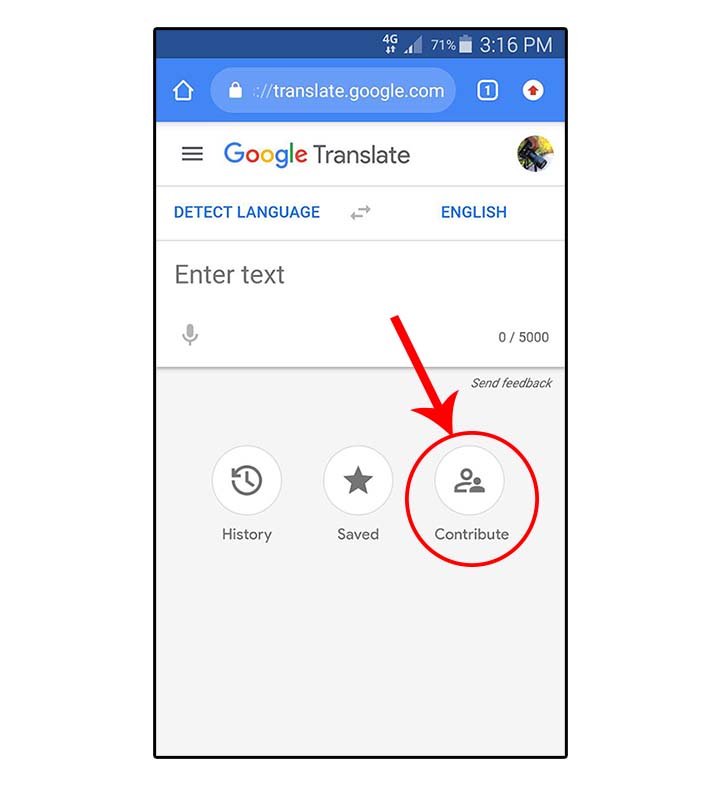
  1. Google Chrome seenaa
  2. Email (Gmail) keessaniin Login godhaa
  3. liinkii kana seenaa, https://translate.google.com/ liinkii kana seenuf filannoo hedduu gargaaramu dandeessu. Fkn, liinkima kana irratti cuqaasuu ykn asirraa laalun saanduqa search keessatti barreessuu.
  4. Contribute kan jedhu seenaa (suuraa asii gadii ilaalaa)


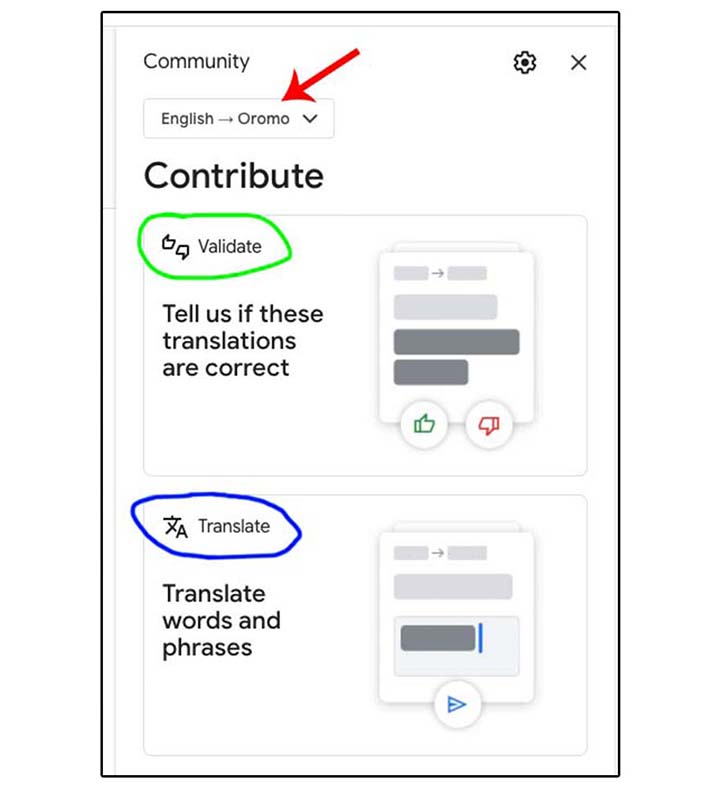
4. Setting > Languages > Gadi bu’aa Oromo filadhaa
5. itti aansun Suuraa asii gadii qalbeeffadhaa


6. Bakka xiyyi agarsiisu ilaalun gara English – Oromo tti jijjiiraa
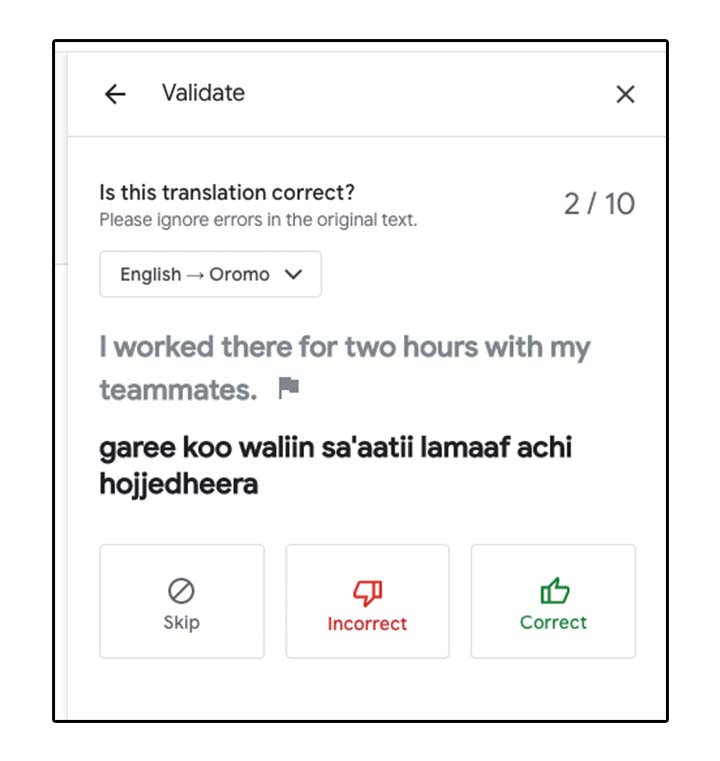
7. Bakka halluu magarisaan haguugame yoo tuqxan kanneen namootni biroo hiikan akka gulaaltaniif isin gaafata. isin kan sirrii ta’ee LIKE kennituuf, kan sirrii hin taane DISLIKE kennituuf. yoo hin beekne SKIP tuquun gara itti aanutti dabartu.


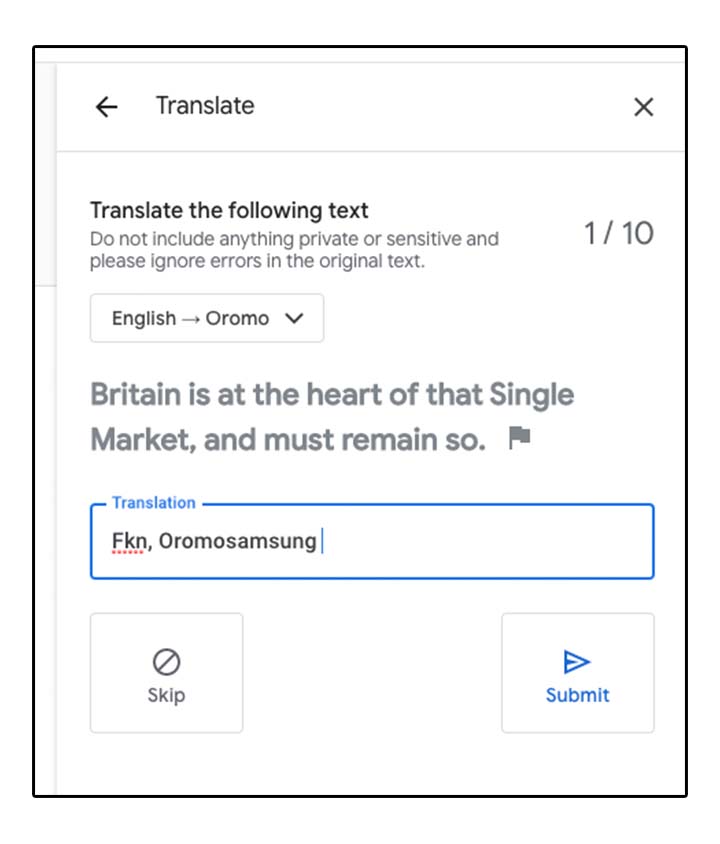
8. Bakka halluu cuqulisaan haguugame yoo tuqxan Himoota Afaan English isiniif fidaa, gara Afaan Oromootti akka hiiktan isin ajaja. ni dandeessu yoo ta’e irratti hirmaachun gahee keessan bahattu.


Suuraan olii kuni, kan namootni hiikan yogguu gulaaltudha


Suuraan kun Himoota haaraya yogguu Afaan Oromootti hiiktu agarsiisa


Dabalata vidiyoo asii gadii ilaalun caalatti hubachuun ni danda’ama.


Hiikkaan Google Afaan Oromoo Faayidaa akkamii qaba? Faayidaan inni qabu hedduudha, isaan keessaa muraasa haa ilaalluu.


• Tarree Afaanota Gurguddoo Addunyaa taa’a.
• Afaan hojii Dhaabbilee Gudrguddoo Idil-Addunyaa tahuuf carraa argata.
• Biyyoota hawaasni Afaan Oromoo dubbatu jiru hundattuu salphatti ittiin-tajaajiluu fi tajaajilamuun hojiirra oola. Akkasuma carraa hojii bal’aa uumufii danda’a.
• Tajaajilootaa fi Oomishaalee Adda addaa salphatti Afaan Oromootiin akka oomishamaniifi raabsaman daandii saaqa.
• Afaan Oromoo Afaan Miidiyaaleen gurguddoon dhimma itti bahan akka tahuuf shoora olaanaa taphata.
• Odeeffannoolee/Barreeffamoota Afaanota Gurguddoo kamiinuu jiru namni barbaadu/hawaasni Afaan Oromoo dubbatu salphatti Afaan Oromootti jijjiiratee dhimma itta baha, akkasumas, barruulee/Odeeffannoolee Afaan Oromootiin bahan qaamni barbaadu kamuu yeroo/biyya barbaadetti Afaan fedheetti jijjiiratee dhimma itti-bahuuf gargaara.
• Marsaaleen hawaasaa gurguddoon yeroo ammaa Addunyaa ganda tokko gochuuf hojjachaa jiran kan akka Feesbuukii, Tiwiitaraa, Telegiraamaa, Instaagiraamaa, LinkidIin, Yuutuubii, fi kkf..niif Afaanota hojii waan tahuuf Guddina Afaanichaatiif shoora olaanaa kaawuu bira darbee Aadaa, seenaa, duudhaa fi sirna Gadaa Oromoo bal’inaan ni beeksisa.
• Afaan Oromoo hirmaannaa Qorannoo fi qo’annoo Idil-Addunyaa tahan, akkasumas Guddina Saayinsii fi Tekinoolojii isa yeroo ammaa addunyaa raasaa jiru keessatti hirmaachuuf carraa akka argatu gochuudhaan, Hawaasichi Afaanicha dubbatus Jijjiirama saffisaa Saayinsiif Tekinoolojiin Addunyaa uumaa jiru kana keessatti akka hirmaatuufi irraa fayyadamu, akkasumas akka waliin tarkaanfatu daandii kan saaquudha.
Walumatti yeroo takkaan Guddina Afaan Oromoo tarkaanfii hedduu gara fuulduratti butuu fi kkf isaan muraasadha.


Maarree Hojii seena qabeessa guddina Afaan Oromoo tarkaanfii 10 ol fuulduratti tarkaanfachiisu kana Ati maal raawwatte? Qooda maal fudhatte? Fira/Maatii/Hiriyoota kee Meeqatti himte/affeerte?
#oroict.com

Monday, December 13, 2021

Baro Tumsa - The Hero of Oromo

Baro Tumsa - The Hero of Oromo


https://youtu.be/tNl09ClOoEM


Baro Tumsa (1938–1978) was a pharmacist, lawyer and Oromo nationalist and political activist in Ethiopia. He was the younger brother of the famed Reverend Gudina Tumsa and mainly responsible for the formation of the Oromo Liberation Front (OLF).


Baro Tumsa was born in 1938, from his father Tumsa Silga and his mother Nasise Chiracho, at Bodji Karkaro in the Wallaga Region of Oromia. His parents died while he was still very young and so he was brought up by his elder brother, Gudina Tumsa.[2] He had one sister (Rahel) and two brothers (Gudina and Nagassa).


Baro Tumsa completed primary education and part of his secondary education in the town of Nekemte, Wallaga, and later in Bishoftu, Shoa. Subsequently, he joined the then Haile Selassie I University in Finfinne and graduated with BSc in Pharmacy, in 1966. Baro was mentored and encouraged to study Law by the likes of Dhinsa Lepisa, and Baqala Nadhi (both lawyers) from the Macha and Tulama Self-help Association and, he re-joined Haile Selassie I University Law School, where he completed his legal education. His LLM thesis entitled "Decentralisation and Nation Building" remains a seminal piece on the issue of national question in the Ethiopian Empire. (now Addis Ababa University).


POLITICAL ACTIVISM


Membership of the MTA:


The Macha and Tulama Self-Help Association (an organisation which was banned in 1966, and some of its leaders were jailed or killed) attracted Oromo students from Haile Selassie I University, including Baro Tumsa (the Chairman of the University Students' Union), Lieutenant Mamo Mazamir, Ibsa Gutama, Mekonnen Gallan, Taha Ali Abdi, and many others. With the exception of Mamo Mazamir, who was martyred in 1969 the rest were founding members of the Oromo Liberation Front (OLF) in 1974. Besides Baro Tumsa, Lieutenant Mamo Mazamir was among the university students who contributed to the radicalization of the Association. This establishes a direct link between the transition from the Macha and Tulama Association to the OLF (Hassen 1996: 75).


Leader of Student Movement:


Baro Tumsa, as the Chairman of Ethiopian Student Union, and his fellow Oromo, the then President of the Parliament secretly arranged for the staging of the first ever 'Land to the Tiller' demonstration against the Haile Selassie regime. Baro Tumsa, cognisant of the fact that the Oromo are usurped their ancestral land by the colonial settlers, is credited for the coining of the slogan 'Land to the Tiller'. The university students not only energized the movement but also raised the famous slogan of 'Land to the Tiller' which became the binding revolutionary slogan for the Ethiopian student movements both at home and abroad. From that day until the unseating of the imperial government, this slogan was never missing from the almost annual event of student anti-government demonstrations (Lata 1999: 191-192). Today, after nearly a half-century, the new generation of Oromo students are rallying under the slogan 'the matter of land is the matter of life' in their resistance against farm-land grabbing.


Organizer:


Most above all Baro Tumsa is admired for two things: First, by his deep and profound understanding of the Oromo cause as a colonial question and his leadership in organising the Oromo was a distinct political force. Second of all, he is revered for his unequalled natural talent of bringing people together. He was singlehandedly instrumental in bringing Oromo from all regions and background together and cementing their unity. Among the Addis Ababa-based underground movement, the brothers Rev. Gudina Tumsa and Baro Tumsa played a very crucial role in keeping alive the spirit of resistance (Zoga 1993: 300-301). They both gave their lives for the Oromo cause.


Ideologue and Founder of the OLF:


In fact, Baro Tumsa was instrumental in the formation of the Oromo Liberation Front. It was he who organized a secret conference in Addis Ababa in December 1973. Among the participants, Hussein Sura (Sheik Hussen), the leader of Beirut-based organization, Elemo Qilixxu, the leader of Aden-based Oromo National Liberation, and Baker Yusuf, came from the Middle East. Several individuals from different regions of Oromia also participated in that conference, out of which the OLF was formed in early 1974.


According to Olana Zoga, the author of History of Macha and Tulama Association, under the leadership of Baro Tumsa, underground members of the Association which gave rise to the OLF took advantage of the February 1974 Revolution and contributed to the overthrow of Haile Sellassie's regime in four ways: First, its members effectively used the limited freedom of the press, which flourished in Ethiopia from March to June 1974 for the purpose of exposing Oromo colonial experience. Second, its parliamentary members regularly challenged many of the regime's policies. Third, its members conducted agitation among the university and high school students. Fourth and most important, the underground members of the military police forces were instrumental in organizing the committee of the men in uniform (Derg or Dergue in Amharic) that overthrew the Emperor in September 1974 Zoga 1993: 301- 302). From this aspect it is very clear that the OLF grew out of the underground Macha and Tulama Association, and it is firmly rooted in Oromo national consciousness and it bases its ideological fire on Oromo nationalism.


Consequently, it can be said that the emergence of a national movement indicates that a population or social group has reached a new stage on the road to nationhood: the transition to political action. The nation, or the sections of a population that consider themselves to be a nation, attempt to create their own state (Alter 1989: 22-23).


Freedom Fighter in the Mountains of Gara Mulata:


Dedicated and visionary leader Baro Tumsa left behind the comfort of his privileged life in Finfinne to join the nascent guerrilla force of the OLF in the eastern command in 1978 and sacrificed his life for the freedom of the Oromo nation. By then he was married and a father of three children. He comes from an unprivileged background and established himself as a member of the urban elite educated and well connected middle class. However, he swapped these luxuries for the hardships in the mountains of Oromia for the sake of the freedom of his people whom he loved with all his heart and mind. The circumstances of his death remains unclear to this day.


Source: Encyclopedia

Saturday, October 23, 2021

28 Health and Nutrition Tips That Are Actually Evidence-Based

It’s easy to get confused when it comes to health and nutrition. Even qualified experts often seem to hold opposing opinions, which can make it difficult to figure out what you should actually be doing to optimize your health.


Yet, despite all the disagreements, a number of wellness tips are well supported by research.


Here are 28 health and nutrition tips that are based on scientific evidence.


Guille Faingold/Stocksy United


1. Limit sugary drinks


Sugary drinks like sodas, fruit juices, and sweetened teas are the primary source of added sugar in the American diet (1Trusted Source).


Unfortunately, findings from several studies point to sugar-sweetened beverages increasing risk of heart disease and type 2 diabetes, even in people who are not carrying excess body fat (2Trusted Source).


Sugar-sweetened beverages are also uniquely harmful for children, as they can contribute not only to obesity in children but also to conditions that usually do not develop until adulthood, like type 2 diabetes, high blood pressure, and non-alcoholic fatty liver disease (3Trusted Source4Trusted Source5Trusted Source).


Healthier alternatives include:


  • water
  • unsweetened teas
  • sparkling water
  • coffee


2. Eat nuts and seeds


Some people avoid nuts because they are high in fat. However, nuts and seeds are incredibly nutritious. They are packed with protein, fiber, and a variety of vitamins and minerals (6Trusted Source7Trusted Source).


Nuts may help you lose weight and reduce the risk of developing type 2 diabetes and heart disease (8Trusted Source).


Additionally, one large observational study noted that a low intake of nuts and seeds was potentially linked to an increased risk of death from heart disease, stroke, or type 2 diabetes (9Trusted Source).


3. Avoid ultra-processed foods


Ultra-processed foods are foods containing ingredients that are significantly modified from their original form. They often contain additives like added sugar, highly refined oil, salt, preservatives, artificial sweeteners, colors, and flavors as well (10Trusted Source).


Examples include:


  • snack cakes
  • fast food
  • frozen meals
  • canned foods
  • chips


Ultra-processed foods are highly palatable, meaning they are easily overeaten, and activate reward-related regions in the brain, which can lead to excess calorie consumption and weight gain. Studies show that diets high in ultra-processed food can contribute to obesity, type 2 diabetes, heart disease, and other chronic conditions (11Trusted Source12Trusted Source13Trusted Source14Trusted Source15Trusted Source).


In addition to low quality ingredients like inflammatory fats, added sugar, and refined grains, they’re usually low in fiber, protein, and micronutrients. Thus, they provide mostly empty calories.


4. Don’t fear coffee


Despite some controversy over it, coffee is loaded with health benefits.


It’s rich in antioxidants, and some studies have linked coffee intake to longevity and a reduced risk of type 2 diabetes, Parkinson’s and Alzheimer’s diseases, and numerous other illnesses (16Trusted Source17Trusted Source18Trusted Source19Trusted Source).


The most beneficial intake amount appears to be 3–4 cups per day, although pregnant people should limit or avoid it completely because it has been linked to low birth weight (18Trusted Source).


However, it’s best to consume coffee and any caffeine-based items in moderation. Excessive caffeine intake may lead to health issues like insomnia and heart palpitations. To enjoy coffee in a safe and healthy way, keep your intake to less than 4 cups per day and avoid high-calorie, high-sugar additives like sweetened creamer.


5. Eat fatty fish


Fish is a great source of high-quality protein and healthy fat. This is particularly true of fatty fish, such as salmon, which is loaded with anti-inflammatory omega-3 fatty acids and various other nutrients (20Trusted Source21Trusted Source).


Studies show that people who eat fish regularly have a lower risk for several conditions, including heart disease, dementia, and inflammatory bowel disease (22Trusted Source23Trusted Source24Trusted Source).https://09f94023b163436f03734bf33e812d8f.safeframe.googlesyndication.com/safeframe/1-0-38/html/container.html


6. Get enough sleep


The importance of getting enough quality sleep cannot be overstated.


Poor sleep can drive insulin resistance, can disrupt your appetite hormones, and reduce your physical and mental performance (25Trusted Source26Trusted Source27Trusted Source).


What’s more, poor sleep is one of the strongest individual risk factors for weight gain and obesity. People who do not get enough sleep tend to make food choices that are higher in fat, sugar, and calories, potentially leading to unwanted weight gain (28Trusted Source29Trusted Source).HEALTHLINE RESOURCEHealthline: Mental Health In Focus


For Mental Health Awareness month, we interviewed Taraji P. Henson, Jewel, Michelle Williams, & more in an honest conversation to bring the state of mental health in focus. Watch the recording here.WATCH NOW


7. Feed your gut bacteria


The bacteria in your gut, collectively called the gut microbiota, are incredibly important for overall health.


A disruption in gut bacteria is linked to some chronic diseases, including obesity and a myriad of digestive problems (30Trusted Source31Trusted Source).


Good ways to improve gut health include eating probiotic foods like yogurt and sauerkraut, taking probiotic supplements — when indicated — and eating plenty of fiber. Notably, fiber serves as a prebiotic, or a food source for your gut bacteria (32Trusted Source33Trusted Source).


8. Stay hydrated


Hydration is an important and often overlooked marker of health. Staying hydrated helps ensure that your body is functioning optimally and that your blood volume is sufficient (34Trusted Source).


Drinking water is the best way to stay hydrated, as it’s free of calories, sugar, and additives.


Although there’s no set amount that everyone needs per day, aim to drink enough so that your thirst is adequately quenched (35Trusted Source).


9. Don’t eat heavily charred meats


Meat can be a nutritious and healthy part of your diet. It’s very high in protein and a rich source of nutrients (36Trusted Source).


However, problems occur when meat is charred or burnt. This charring can lead to the formation of harmful compounds that may increase your risk for certain cancers (37Trusted Source).


When you cook meat, try not to char or burn it. Additionally limit your consumption of red and processed meats like lunch meats and bacon as these are linked to overall cancer risk and colon cancer risk (38Trusted Source39Trusted Source40Trusted Source41Trusted Source).


10. Avoid bright lights before sleep


When you’re exposed to bright lights — which contain blue light wavelengths — in the evening, it may disrupt your production of the sleep hormone melatonin (42Trusted Source).


Some ways to help reduce your blue light exposure is to wear blue light blocking glasses — especially if you use a computer or other digital screen for long periods of time — and to avoid digital screens for 30 minutes to an hour before going to bed (43Trusted Source).


This can help your body better produce melatonin naturally as evening progresses, helping you sleep better.


11. Take vitamin D if you’re deficient


Most people do not get enough vitamin D. While these widespread vitamin D inadequacies are not imminently harmful, maintaining adequate vitamin D levels can help to optimize your health by improving bone strength, reducing symptoms of depression, strengthening your immune system, and lowering your risk for cancer (44Trusted Source45Trusted Source, 46Trusted Source47Trusted Source).


If you do not spend a lot of time in the sunlight, your vitamin D levels may be low.


If you have access, it’s a great idea to have your levels tested, so that you can correct your levels through vitamin D supplementation if necessary.


12. Eat plenty of fruits and vegetables


Vegetables and fruits are loaded with prebiotic fiber, vitamins, minerals, and antioxidants, many of which have potent health effects.


Studies show that people who eat more vegetables and fruits tend to live longer and have a lower risk for heart disease, obesity, and other illnesses (48Trusted Source49Trusted Source).


13. Eat adequate protein


Eating enough protein is vital for optimal health, as it provides the raw materials your body needs to create new cells and tissues (50Trusted Source).


What’s more, this nutrient is particularly important for maintenance of a moderate body weight.


High protein intake may boost your metabolic rate — or calorie burn — while making you feel full. It may also reduce cravings and your desire to snack late at night (51Trusted Source52Trusted Source).HEALTHLINE NEWSLETTERSign up for daily nutrition tips and tricks


Healthier eating shouldn’t be a hassle. We’ll send you our evidence-based tips on meal planning and nutritionEnter your emailGET STARTED


Your privacy is important to us


14. Get moving


Doing aerobic exercise, or cardio, is one of the best things you can do for your mental and physical health.


It’s particularly effective at reducing belly fat, the harmful type of fat that builds up around your organs. Reduced belly fat may lead to major improvements in your metabolic health (53Trusted Source).


According to the Physical Activity Guidelines for Americans, we should strive for at least 150 minutes of moderate intensity activity each week (54Trusted Source).


15. Don’t smoke or use drugs, and only drink in moderation


Smoking, harmful use of drugs, and alcohol abuse can all seriously negatively affect your health.


If you do any of these actions, consider cutting back or quitting to help reduce your risk for chronic diseases.


There are resources available online — and likely in your local community, as well — to help with this. Talk with your doctor to learn more about accessing resources.


16. Use extra virgin olive oil


Extra virgin olive oil is one of the healthiest vegetable oils you can use. It’s loaded with heart-healthy monounsaturated fats and powerful antioxidants that have anti-inflammatory properties (55Trusted Source56Trusted Source).


Extra virgin olive oil may benefit heart health, as people who consume it have a lower risk for dying from heart attacks and strokes according to some evidence (57Trusted Source).


17. Minimize your sugar intake


Added sugar is extremely prevalent in modern food and drinks. A high intake is linked to obesity, type 2 diabetes, and heart disease (1Trusted Source2Trusted Source58Trusted Source).


The Dietary Guidelines for Americans recommend keeping added sugar intake below 10% of your daily calorie intake, while the World Health Organization recommends slashing added sugars to 5% or less of your daily calories for optimal health (5960Trusted Source).


18. Limit refined carbs


Not all carbs are created equal.


Refined carbs have been highly processed to remove their fiber. They’re relatively low in nutrients and may harm your health when eaten in excess. Most ultra-processed foods are made from refined carbs, like processed corn, white flour, and added sugars.


Studies show that a diet high in refined carbs may be linked to overeating, weight gain, and chronic diseases like type 2 diabetes and heart disease (61Trusted Source62Trusted Source63Trusted Source64Trusted Source).


19. Don’t fear saturated fat


Saturated fat has been controversial, and in the past, it was thought to be a major contributor to heart disease (65Trusted Source).


While it’s true that saturated fat raises cholesterol levels, it also raises HDL (good) cholesterol and reduces small, dense LDL (bad) cholesterol particles, which is linked to a lower risk of heart disease (66Trusted Source).


Emerging research has questioned the association between saturated fat intake and heart disease. It appears that saturated fat may actually have no impact or a slightly positive impact on overall health as long as your overall diet is healthy and nutritionally balanced (67Trusted Source68Trusted Source).


20. Lift heavy weights


Strength and resistance training are some of the best forms of exercises you can do to strengthen your muscles and improve your body composition.


It may also lead to important improvements in metabolic health, including improved insulin sensitivity — meaning your blood sugar levels are easier to manage — and increases in your metabolic rate, or how many calories you burn at rest (69Trusted Source70Trusted Source).


If you do not have weights, you can use your own bodyweight or resistance bands to create resistance and get a comparable workout with many of the same benefits.


The Physical Activity Guidelines for Americans recommends resistance training twice per week (71Trusted Source).


21. Avoid artificial trans fats


Artificial trans fats are harmful, man-made fats that are strongly linked to inflammation and heart disease (72Trusted Source).


Avoiding them should be much easier now that they have been completely banned in the United States and many other countries. Note that you may still encounter some foods that contain small amounts of naturally occurring trans fats, but these are not associated with the same negative effects as artificial trans fats (73Trusted Source).


22. Use plenty of herbs and spices


There is a variety of herbs and spices at our disposal these days, more so than ever. They not only provide flavor but also may offer several health benefits as well (74Trusted Source).


For example, ginger and turmeric both have potent anti-inflammatory and antioxidant effects, which may help improve your overall health (75Trusted Source76Trusted Source).


Due to their powerful potential health benefits, you should aim to include a wide variety of herbs and spices in your diet.


23. Nurture your social relationships


Social relationships — with friends, family, and loved ones you care about — are important not only for your mental well-being but also your physical health.


Studies show that people who have close friends and family are healthier and live much longer than those who do not (77Trusted Source78Trusted Source).


24. Occasionally track your food intake


The only way to know exactly how many calories you eat is to weigh your food and use a nutrition tracker, as estimating your portion sizes and calorie intake is not unreliable (79Trusted Source80Trusted Source).


Tracking can also provide insights into your protein, fiber, and micronutrient intake.


Though some studies have found a link between tracking calories and disordered eating tendencies, there is some evidence that suggests that people who track their food intake tend to be more successful at losing weight and maintaining their weight loss (78Trusted Source81Trusted Source82Trusted Source83Trusted Source).


25. Get rid of excess belly fat


Excessive abdominal fat, or visceral fat, is a uniquely harmful type of fat distribution that is linked to an increased risk of cardiometabolic diseases like type 2 diabetes and heart disease (84Trusted Source).


For this reason, your waist size and waist-to-hip ratio may be much stronger markers of health than your weight.


Cutting refined carbs, eating more protein and fiber, and reducing stress (which can reduce cortisol, a stress hormone that triggers abdominal fat deposition) are all strategies that may help you get rid of belly fat (85Trusted Source86Trusted Source87Trusted Source88Trusted Source).


26. Avoid restrictive diets


Diets are generally ineffective and rarely work well long term. In fact, past dieting is one of the strongest predictors for future weight gain (89Trusted Source).


This is because overly restrictive diets actually lower your metabolic rate, or the amount of calories you burn, making it more difficult to lose weight. At the same time, they also cause alterations to your hunger and satiety hormones, which make you hungrier and may cause strong food cravings for foods high in fat, calories, and sugar (90Trusted Source91Trusted Source).


All of this is a recipe for rebound weight gain, or “yoyo” dieting.


Instead of dieting, try adopting a healthier lifestyle. Focus on nourishing your body instead of depriving it.


Weight loss should follow as you transition to whole, nutritious foods — which are naturally more filling while containing fewer calories than processed foods (14Trusted Source).


27. Eat whole eggs


Despite the constant back and forth about eggs and health, it’s a myth that eggs are bad for you because of their cholesterol content. Studies show that they have minimal effect on blood cholesterol in the majority of people, and they’re a great source of protein and nutrients (92Trusted Source93Trusted Source).


Additionally, a review involving 263,938 people found that egg intake had no association with heart disease risk (94Trusted Source).


28. Meditate


Stress has a negative effect on your health. It can affect your blood sugar levels, food choices, susceptibility to sickness, weight, fat distribution, and more. For this reason, it’s important to find healthy ways to manage your stress.


Meditation is one such way, and it has some scientific evidence to support its use for stress management and improving health (95Trusted Source96Trusted Source).


In one study involving 48 people with high blood pressure, type 2 diabetes, or both, researchers found that meditation helped lower LDL (bad) cholesterol and inflammation compared with the control group. Additionally, the participants in the meditation group reported improved mental and physical wellness (97Trusted Source).


https://www.healthline.com/nutrition/27-health-and-nutrition-tips#TOC_TITLE_HDR_29

Most Recent

Admas Digital Lottery 19th round winning numbers are announced

  Admas Digital Lottery 19th round winning numbers are announced Accordingly the following are winning numbers for Admas Digital Lottery 19t...